

January 9, 2024
Mesmerized by our first two nights in India, we awoke slightly earlier than usual, yet most certainly eager to experience India’s primary education. The trip took us to a different side of Mumbai–a more centered but representative of what we have been observing of what is, a city constantly evolving, bit by bit, and so vast and encompassing of all that India holds–aspirations, challenges, and post-colonialism (deprived of resources and keenly integrated within the international global market).
A city that holds more than 21 million people provides a grounding opportunity for us as we ride the bus to get a glimpse of a unique experience not afforded to many of the 21 million people. Still, it allows us to see a “mission” school in action–a school classified as tier 1 and only available to those who can afford the high price. As I sit on the bus, unable to sleep, despite my lack of sleep, I think about what will await us inside those doors. Will it be a traditional, historical “mission” school prioritizing obedience and compliance, or will it be a different experience that sheds light on new educational approaches?
To my surprise (yet I am finding out that I shouldn’t be surprised), upon entering the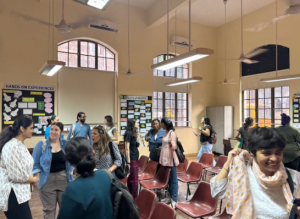 school grounds, there were smiles and a visible sign that schooling here represents a deep investment in teaching the child–not only through the mind but with the heart. You can observe a few representations of what we see as we walk the Cathedral Primary (Junior School) halls.
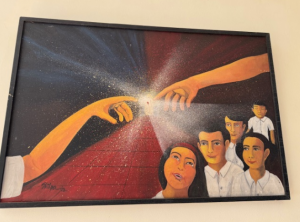
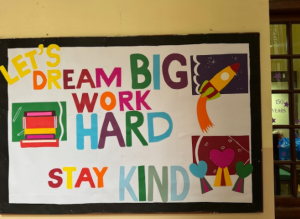
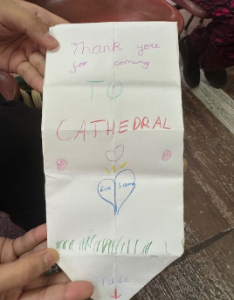 The students exuded joy, and the teachers, largely representative, provided engaging lessons that showed us an interesting alignment with schooling in America. In fact, to many of us, it was as if we were suddenly transported to a school in the USA. Since the medium of instruction is in English, there were clear signs of American influence, including in the instructional lessons and school items, as you can observe based on the pile of backpacks in this picture.
Though we can see the contentions of compliance education in some instances, from my perspective, the large number of students that we observed seemed eager to learn, share a joke with a friend, and run, yes run, to get a drink of water (I couldn’t even do this in my elementary school in America)!
As we gathered our thoughts, we were honored with the opportunity to meet the teachers. What continues to strike me is the deep dedication to their school–a sense of ownership that is something to elevate. From being in the school for many years to feeling like they have a voice and a deep sense of pedagogical practices, the teachers at this school demonstrate, perhaps, an outlier experience of the vast majority of teachers and schooling in India. In this particular school, within its context, I contend with the notion that these teachers hold education in their hearts and care for each child entrusted to their care. It might be that a school that pays more than others (according to the head of the school) and enrolls only students and families that can afford this education should embody these aspects; however, I still would like to believe that it is their love of teaching that drives the work, and I think there are plenty of representations that can illustrate this point. For now, though, I take this moment in time, hold it close, and continue to hope that an excellent education, like the one we saw, and one that expands much more toward a whole child education framework, should be available to all students!
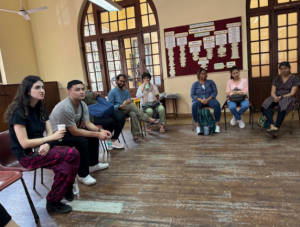
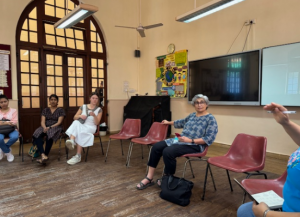
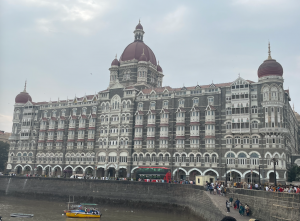
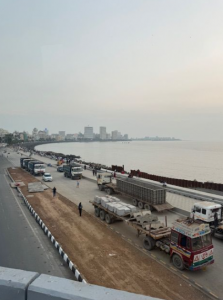
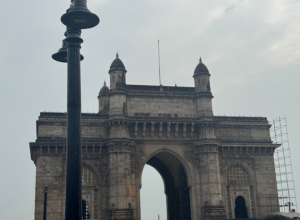
I won’t end without saying that the thali we had in our first Indian restaurant experience was blissful (on a personal note, I hit the peak of spice in what might be the hottest India can offer). It was an enjoyable afternoon walking with an experienced guide to reflect on the colonial legacy of the Gateway to India, driving along the Marine Drive, and experiencing some of the continued impact of the Tata families’ business–the Taj Mahal Hotel.
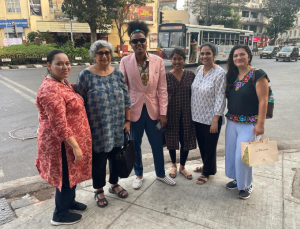 Dr. Kalyanpur shared, “some of us had the great good fortune of a chance encounter with one of India’s leading scholars on caste, Suraj Yengde, and Associate at Harvard university, one the streets of south Mumbai (thank you, Shama, for your sharp eye!). Dr. Yengde’s book, Caste Matters, is a deeply autobiographical analysis of caste; its title, as many of you might have noticed, is a tribute to his mentor, Cornell West.”
Tonight, we sleep eagerly, anticipating another early morning, another opportunity to hold people close to our hearts and minds.