

Day 1: Landing in India!
January 07, 2024
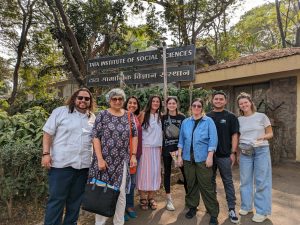 On January 7th, our group trickled into the Tata Institute of Social Sciences (TISS), getting to know one another via breakfast, lunch, and dinner. Our group of Master’s and Ph.D. students enjoyed numerous meals of savory and sweet cuisines, within a quiet cafeteria set on a quiet campus.
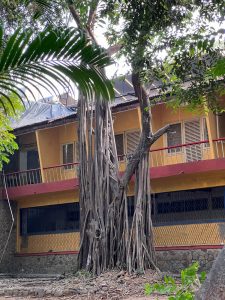

Mid-day, we toured the old and new campus’, with students from TISS as our tour guides. The entire campus is surrounded by neighborhood and city streets, and the grounds are littered with trees. We viewed resident bats living in the trees, and we were informed that monkeys lurk throughout. Our walk allowed us time to get to visit the library and get to know a few of the students from the TATA Institute.
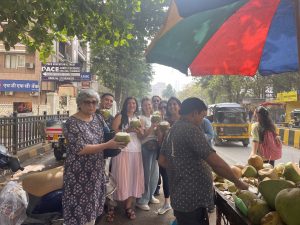
Short adventures outside the campus provided a view of the street climate (vendors, traffic, and protestors), a view of the nearest grocery store, and a visit to the local eatery. Throughout the day, we challenged the time zone trauma, and most of us won the battle with a bedtime no sooner than 8:45 PM.
Day Two
January 08, 2024
Day 2 was a different ball game. On Monday, January 8th, the cafeteria reached max capacity with guests from inside and outside the country of India. It was shoulder to shoulder. We nibbled both Western and Indian cuisine before venturing to the top floor for a solid day of discourse related to India’s educational history and the current status of education in India. For the next several hours, we conferenced with the professors and students representing TISS. Guest lectures were provided by Dr. Nandini Manjrekar and Dr. Meera Chandran. We discussed the educational entanglements of India, including colonialism and religion. We discussed how Indian education is stratified by religion, colonialism, nationalism, and missionary education. Dr. Manjrekar explained to us how “the bible and the sword were not the mechanisms of colonialism,” and that “the motive was the Christian faith, but conversion was not a must. We also critically discussed the role of the caste system, the ideology that to be considered educated, you must appear liberal, and the socially just work of Dr. B.R. Ambedkar. We learned that India’s affirmative action is branded as positive discrimination, and policies tied to 1991 and the Pandemic of 2020 have done more harm than good. As an example, the Right to Education (RTE) policy fails to include necessary systemic supports for implementation: funding, qualified teachers, and community buy-in. Throughout the day, we identified numerous parallels between the educational systems and practices of India and the United States of America. It was as if policies were interchangeable.
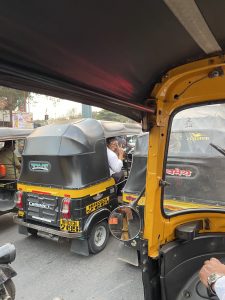
A late afternoon break provided for a visit to the local market and a wild Rickshaw ride.
The evening debrief brought about a few of the following discussion topics:
- We know the information, and now what are we going to do with it in the
 United States?
 - Let us recognize the power of the Empire (inclusive of policies & practices) and why it continues to be a model.
- There have been pockets of resistance, and let us not forget/discount the tribal resistors.
- There is still hope.